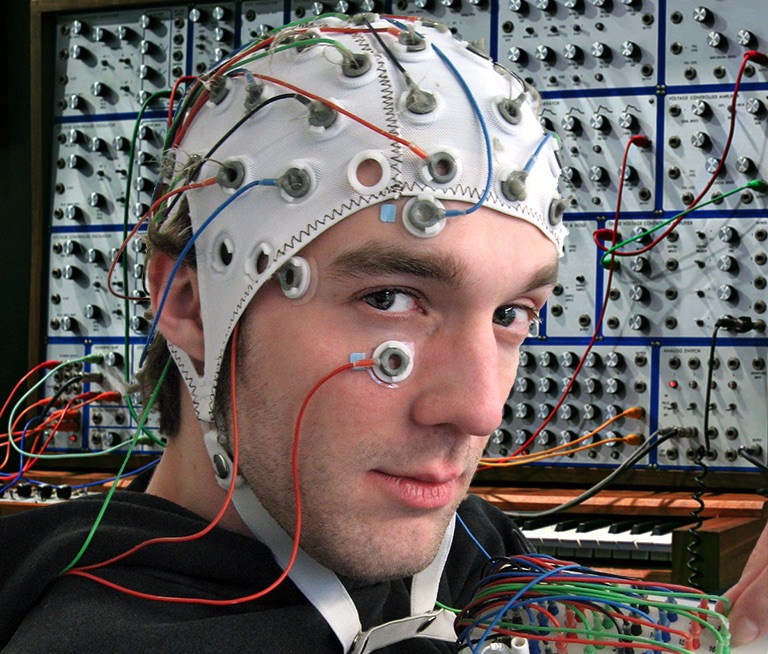
The fact that our brains are electrical is a relatively new discovery.
The first article about electrical phenomena in the brains of monkeys and rabbits was published in the British Medical Journal of 1875.
Nearly a half century would pass before the first human EEG (electroencephalogram) was recorded. That distinction would go to German psychiatrist and physiologist Hans Berger who invented the device that would begin the field of electroencephalography.
The 4 Building Blocks of Consciousness
There are 4 basic brain wave frequencies and each correlates with a specific state of consciousness. Like sound frequencies, brain waves are measured in Hz, or cycles per second. In general, the slower the frequency of your brain waves, the more relaxed you feel.
Meditation, neurofeedback, hypnosis, and guided imagery have all been shown to help people control their brain waves more efficiently for better health, higher performance, and a more positive experience of life.
Beta Waves: 13-30 Hz
Your brain is producing beta waves as you are reading this. A predominance of beta waves is associated with being alert, active, and whenever you concentrate on learning something or doing an activity that requires focus.
Beta waves are also associated with over-thinking and worry. While the beta state has gotten a bad rap in some meditation circles, you need your brain to generate beta waves in order to think and function consciously.
But when you want to relax, it’s time to shift into alpha.
Alpha Waves: 8-13 Hz
Alpha is the brain wave associated with relaxed, daydreaming states of mind; it’s a state of relaxed, detached awareness. Many people are “in alpha” while watching TV. Alpha is often called a “hypnogogic” state because you may experience spontaneous mental imagery.
If you’re like most people, when you close your eyes and take a few slow, deep breaths you’ll experience a light, relaxed alpha state. Alpha is considered the gateway to meditation. Some people consider alpha waves to be the link between the conscious mind and the subconscious.
You produce alpha waves when you relax to guided imagery. Your brain also produces alpha waves just before you drift off to sleep and just before you wake up. At the beginning of “stage 1 sleep” alpha waves disappear and theta waves appear.
Theta: 4-8 Hz
Theta waves are often associated with deep states of meditation, peak spiritual experiences, and higher states of consciousness. Theta waves are associated with drowsiness or arousal in adults and older children. Young children are in theta most of the time.
Some people consider the theta state to be synonymous with the subconscious mind wherein reside suppressed emotions, as well as a storehouse of creativity. Theta is associated with REM (rapid eye movement) sleep where dreams occur.
Delta: up to 4 Hz
Delta waves occur in adults during deep, or “slow wave” sleep. It seems this state is needed by the brain because after a period of sleep deprivation, there’s usually a rebound of slow wave sleep. Alcohol interferes with delta wave sleep. A low carbohydrate diet has been shown to increase the amount of delta activity and deep sleep in healthy individuals.
Delta states sometimes occur during continuous attention tasks.
Delta is considered by some to be the bridge to what Carl Jung described as the “collective unconscious.” Babies are in delta much of the time. For some reason adult females have been shown to have more delta wave activity. This is true not just in humans but in most mammals.
Beyond the Basic Brain Waves
Gamma: 25-100 Hz
Neurologists have also described a Gamma brainwave that’s thought to be involved with our sense of conscious awareness. Gamma waves range in frequency from 25 to 100 Hz though usually they are around 40 Hz. Studies of Tibetan Buddhist monks have shown a correlation between gamma waves and transcendental states of consciousness, but not all neuroscientists are convinced.
Mu 8-13 Hz
The Mu wave is a brain frequency which has been observed and studied since the 1930’s. Mu waves are in the range of 8-13 Hz and arise from large groups of neurons in the brain.
Recently Mu brain waves have been associated with the “mirror neuron” system that activates when we watch another person’s activity. Because mu brain waves may play a role in our ability to understand and imitate others’ behavior, enhancing mu wave activity via neurofeedback is being studied as a therapy for autism. Early results are promising.
Photo Credit
Related Posts:
Hello,
I’m going to describe an experience I had a week ago or so while meditating in hopes of receiving your opinion on what was happening in my brain. Your response is very appreciated!..
I was driving home from work and practicing in the moment meditation and deep breathing at the same time while focusing my aural energy to the point directly between my eyes, which results for me in a feeling of being touched in that spot. All of the sudden, my thoughts seemed to melt away. My entire body relaxed. Colors became much more vibrant, sounds more clear, and my sense of physical feeling heightened as well. I found myself aware of my entire body at once. Not only that, but aware of everything around me, seemingly at the same time. Trees. Animals. Other people. I could see, smell, feel, and hear everything, and even taste the air. This experience kept growing in intensity like a tidal wave. At the peak of the experience, I wasn’t even anticipating things, I seemed to just know what was next. Also during the peak, I felt everything around me vibrating at an incredible rate. Even the air. I came to a place where it was my perception that I was not even in this dimension, but a ball of energy slicing through what seemed to be a paper reality. All of this happened while I was driving my car. I know, it sounds dangerous, but I know it wasn’t because I was able to just know what was going to happen next. Like if a car was going to pull out of a hidden driveway for example, I seemed to know those things in advance of them happening.
What I’m wondering is, with your knowledge, if you could possibly speculate as to what was going on there. What type of dominant brain wave activity I was experiencing? My son believes it to be gamma but if it were, it was far higher gamma than I’ve ever felt playing sports or having been in “flow”. I’m going to continue to try and reproduce the experience as well. Thank you.
Thanks for sharing your experience. Short answer: Not all states of consciousness are explained by electrical activity in the brain.
Very interesting article. I found this when trying to understand the phenomena I am experiencing.
I woke up from an 8 hour sleep. Very difficult to arouse myself and function. Then could function (I.e. Drive a car but I still feel “half-awake). I suspect that if i laid down I could sleep easily. What’s going on there?
Thanks for any thoughts
Hi Ally,
There are many more factors other than hours of sleep involved with feeling rested. For example, we sleep in 90 minute cycles and will feel most rested when that 90 minutes is not interrupted. It also depends on your circadian rhythm, which is how your body is synchronized to hours of sunlight, so it matters when you go to sleep and what time you awake and how much blue light you get in the morning. Also, you may not be sleeping quite deeply enough due to stress, food, alcohol, or many environmental factors.
Hi I was just wondering about anger and what frequency the brain runs on in a state of anger. We all know that people can act quite irrationally when angry and I was wondering if the brain function is limited due to the frequency the brain is operating on in that angry state.
Thanks in advance Tamarene O’Connor
Hello Linda, from the resources I’ve read. They all state that REM sleep reflects beta frequency,as if one is awake but you have indicated that it is reflected in theta waves, may I get clarification on where you got your source on that point. Thank you
I’ve seen both mentioned in different articles.
http://thoughtmedicine.com/2011/06/brain-wave-basics-what-you-need-to-know-about-states-of-consciousness/
I have been chanting a lot since a recent surgery.
I have found myself returning to the use of both
binaural and isochronic audio files. While I knew
of gamma frequencies, the mu bandwidth was a new
one on me. I have pondered the following, if slower
frequencies slow one’s brain down for the sake of
relaxation, will faster frequencies not only accelerate
one’s brain, will they also enhance the level of
neuro-connectivity as in increase the number of connections
within the matrix of the brain’s neural pathways?
Namaste’
Scot
https://www.youtube.com/watch?v=DWOX35cs61U
It’s important to remember that when we speak about different brainwaves that we’re talking about predominant brainwaves. Our brains are almost always producing a mixture, so it’s a bit of an oversimplification to make too strict of a correlation. In general, the more predominant the slower waves are, the more relaxed one feels. However, it seems there are states of meditation where the body is relaxed yet the brain is quite active. We are just beginning to explore the connection between the brain and consciousness. In my opinion, the brain is more of a transmitter of consciousness rather than the generator. Just an opinion! 😉
Your statement about theta waves was really interesting. It’s cool to know that young children are in theta states the majority of the time, but adults only experience it when they are unusually tired of aroused. Maybe this is why children are considered to have a spiritual state of consciousness.
Linda, Which state would you reccomend operating in? More specifically, If I were to meditate before starting my day, which frequency do you reccomend I aim for? I’m a fighter, before going into a fight or a training session, would yoh reccomend a gamma state or an alpha state? I’ve read that alpha waves grant you the ability to make greater decisions because your brain spends more time at each thought before moving to the next one, what are your thoughts on that? Last question I swear, do you believe it’s possible for the brain to be at a gamma level, while the body stays completely relaxed? I hope you don’t mind all the questions, and I sincerely hope you answer, this is truly fascinating. Thank you for the great article regardless.
Interesting question. Traditional martial arts always involve meditation which would take one more toward the alpha state. Also, we are just beginning to understand the relationship between brain frequencies and states of consciousness.
I have had 2 eegs and i am told that my brain waves are at 7 hz. I am waiting to see my neuroligist at the end of this month to see what he thinks.
I have cery scary and vivid dreams when i am sleeping. During the day i never seem to wake up all of the way. My head feels sluggish and most of the time i feel like i am in a fog. Do you know what would cause this. I am very worried because my memory is very bad.
Thanks
I’m not a health professional so I can’t offer an opinion. I hope you find some relief when you see your neurologist. Good luck to you and thanks for your question.
Hi Linda,
Can you elaborate on effects of brainwave on our thoughts
Interesting question. More research needed. I suspect it’s more a case of the effects of our thoughts on our brainwaves hence the adage, “Change your thoughts, change your mind.”
I have a question. When I move into a state of meditation or hypnosis I begin seeing colored lights floating everywhere like small diaphanous clouds. Often I still see them even if I open my eyes and also then everything looks luminous. (Often my new hypnosis clients start seeing these colors too when they hadn’t ever seen them before.) Is there a certain brain wave state associated with seeing these colored light?
I have had this experience too, and my hypnosis clients have reported similar colors, especially as they begin to relax. I’m guessing they may be correlated to alpha or theta but there’s also the possibility they are connected with 6th chakra opening. But that’s a whole other discussion! Thanks for your question.
At one time I had a Jr IQ machine with programs, light glasses and audio input. I lost it in a move. I would be interested in buying one used if possible. Sharper image sold it but no longer does. I had some incredible experiences during the time of use. Brain wave programing is something I would be interested in. Is there as way to learn these states without the hardware? Thanks for your time and efforts.😆
Meditation practice is the best lo-tech method! Many people benefit from music with binaural beats.
Why s it, with all this info about slower brain waves having higher amplitude and healing…that none of the “scientific community” asks the simple question “What does it take to get the brain to “reset to default” after drifting, shortly after infancy, into “brain distractive mode?” Logic would say, that, for distractions to cease, one’s return from them, would have to amount to…nothing. “Leave no stone unturned.” This is self death, and self IS the illusion creating the distractions. But the road to get there, requires a, first, self actualized brain (where the male becomes one with the female). With so much brain degeneration from the “distractive modes” feedback loop excesses, few people get out of the starting blocks to achieve “one brain” self actuallization, let alone self death as the second wave of inner evolution.
Yes Vipassana… see http://www.dhamma.org
Any reliable information on this subject would be greatly appreciated. Just a nod in the right direction, perhaps? frankertron@outlook.com
…“hypnagogic” state
Hi Linda, thanks for all the information!
I am interested to know which is the simple meditation for achieving conscious theta state. Is there any other meditation which is free from imagery and mental pictures and relies on inner truths for this theta meditation.
Thanks
Winston, you can induce theta brainwaves with binaural tones. They were developed by Heinrich Wilhelm Dove in 1839. Binaural tones are sounds with different frequencies being played in each ear. Like if tones with 30 Hz frequency get played in one ear and 36 Hz in the other, the binaural tone is the difference between the two (36-30 = 6). 6 Hz falls into the 4-8 Hz theta range, so our brains “entrain” the binaural tones by inducing more theta brainwaves.
Can listening to these different waves using headphones cause any sort of damage or ill effects?
Hello John,
Because these frequencies are too low for the human ear to perceive, they cannot be listened to directly. You may be referring to something called binaural sound recordings that use a technology that plays two different frequencies, one in each ear. This method claims to be able to create an unheard frequency which the brain is thought to “entrain” with. To date there has been limited research, but you can learn more about this technology here: http://en.wikipedia.org/wiki/Binaural_tones
Madam. Linda Gabriel may i can learn about yoga online form you cause i heard about your good exprience.
There are lots of sources for yoga instruction online. Try gaiam.com or yogisanonymous.com
Hi Linda,
I have a 17 yr old son who has had nocturnal enuresis his whole life. I have finally learned this is a parasomnia, effecting him in deep sleep. Is there a way to help him decrease time in deep sleep so that he can move into a more wakeful sleep pattern, and can therefore respond to his bladder?
Hypnosis can be helpful, but there is new research indicating neurofeedback is an excellent treatment for your son’s problem. Neurofeedback trains the brain to regulate it’s own brainwaves using simple video games. It’s non-invasive and even fun. I suggest finding a neurofeedback practitioner who is familiar with the specific method described in this article: http://www.newswise.com/articles/neurofeedback-offers-effective-treatment-for-bedwetting
Thanks for your question and good luck to you and your son.
Hi Linda. I am researching theta brainwaves in children and am trying to understand the age delineation from when young children are mostly in theta to when children experience theta mostly in slumber. Thoughts?
Hi Melody,
I doubt there’s a definite boundary line and that this varies widely among individuals. There’s a lot of recent research. You might start here: http://www.clinph-journal.com/article/S1388-2457(06)00009-5/abstract
Thank you Linda, I found your article and this link both fascinating. Thanks for the high level this research have and the number of publications I´ve been allowed to read.
Two kisses from Spain.
Hi Linda
Can you test sounds to find out what beta waves they produce?
Hi Melissa. I personally don’t have the ability, but there has been research showing that “binaural” sounds can help the brain entrain to different frequencies. Because of the low hertz of brain waves, the human ear cannot hear those frequencies, but if you play one frequency in one ear, say 440 Hz, and a slightly different frequency in the other, such as 447 Hz, the brain tries to resolve the difference by generating a third frequency of 7 Hz. This frequency is not heard but the brain can entrain to it. At least theoretically. Neurofeedback is another technique but it doesn’t involve sound. Thanks for your question!
I am curious about a phenomenon I have noticed when half asleep. There is a noise I hear a lot while in bed, made by my air conditioner thermostat. It’s a noise that normally is a click. However, sometimes when waking I perceive that noise as a ping. I am wondering if there is a correlation between slowed brain wave and perceived sound frequency.
Good question Dalton. I’ve experienced some interesting audio effects when I’m about to fall asleep. I wouldn’t be surprised if there’s a correlation with brain wave activity though I doubt anyone will fund a study! Thanks for visiting and leaving a comment.
Hello,
I was searching the net because of unusual sounds that I hear usually during napping and occasionally when when waking up. I hear a white noise that gets louder and louder. My heart beats really fast as I try to wake myself up. I know that I am sleeping. I am aware of my surroundings but I can’t stop this noise or wake up. Also, sometimes right before I wake up, I hear foot steps and noises that seem quite real to my conscious mind because I am aware of my surroundings even though I am not fully awake. No doubt this is coming from my brain waves. Can you tell me what you think could be going on?
Could be an auditory form of sleep paralysis where the brain wakes up before the body does.
Hi Linda!
I just had an exam on this for my Psych class! I think your website is going to become even MORE useful to me now as I dig deeper into my psychology studies. We’ll have to keep in touch!
Courtney
Hi Courtney,
Yes, by all means! Thanks for stopping by.
I would really enjoy seeing a follow up article offering some suggestions of how I can apply this knowledge.
Very interesting article! I had recently read about Theta waves and am glad to get a general explanation of the other forms of brain waves.
Hi Debbie,
Yes, it is interesting that children are in theta most of the time. And the newest research on the gamma and mu waves is indeed fascinating.
Thanks for stopping by!
Thank you for a very educational post. IO thought I knew a lot about brain waves, but I definitely learned something.
I did not know children spend most of the time in theta. How interesting…and then we spend the rest of our lives trying to get back to that kind of mind.
I also did not know about the gamma and mu waves. Fascinating developments.
Yes! Makes one consider what they are exposed to, not only at home, but in the media.